Defining Requirements
|
When you define a process, specify data, training or testing you need to state the criteria (or requirements) to define the use of that item.
|
|
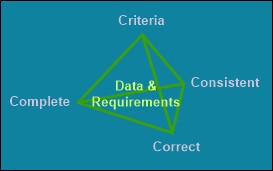
The application of the ideas of correct, complete and consistent will differ slightly for processes, data, training or testing, although the principles remain the same. When applying across processes, data, training and testing there will be interactions and some examples will be used.
The ideas are more obvious for data. That data needs to be correct is a given. However the correctness of data can be time dependent, so it is necessary that there is a process to keep it up to date. This is a process that does not arise directly from the business model. But data does just not exist; a process has to exist to create and maintain it. Part of the completeness for a data; one or more processes are needed to keep it appropriately maintained. For data to be complete, you have to know the criteria for the processes with which it is associated. What are the processes trying to achieve and therefore what data is required. One of the issues for modern systems is that they are real (or pseudo-real) time. Data can therefore be used as soon as it entered. Data can be entered incorrectly, therefore the process is incomplete unless it can handle incorrect data. However the users need to be aware of what to do in the event of incorrect data being entered, so training is incomplete if it does not cover error scenarios. Testing is also incomplete if it does not handle error scenarios. It is usually simple to test for correct operation; incorrect operation is often more difficult and may get missed if time is tight. However once live, errors will absorb more effort than correct operation. So when defining the criteria to govern the operation of a process, testing or training, it is necessary to consider both the correct and incorrect scenarios to produce a robust system. The requirement to 'get it right first time' and detect errors in data before being released for use will significantly aid the robustness of any process and system. Very simple rules can often yield significant benefits.
©2025 Alex Cranswick